Nathan Brandman-Hughes
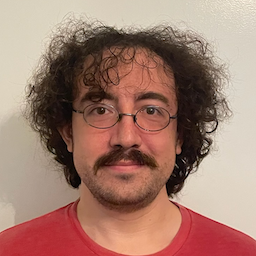
Advisor: Rick Cavanaugh
Mentor: Sergo Jindariani
Undergraduate: University of Missouri-Kansas City (Physics)
Graduate: University of Illinois Chicago (Physics)
Project: Level 1 Trigger for a Muon Collider
Developing a level-1 trigger algorithm for a potential future muon collider. The goal was an algorithm that could be implemented on an FPGA and would be capable of reconstructing charged particle tracks to identify events of interest, in this case the focus was on Higgs to dimuon events. Nathan implemented a kalman filter, written in c++ High-level Synthesis (HLS) code with the focus largely being on optimizing the HLS code to parallelize operations to reduce latency for the many matrix operations needed. One of the main challenges encountered was the large expected radiation background that would be produced by the relativistic muons in the collider, which creates a serious combinatorics problem, and the strict timing requirements of 10 micro-seconds between bunch crossings. To cut down on the combinatorics, all hits are first filtered based on a calculated corrected time of arrival where the flight time of the particle causing the hit is calculated assuming it originated at the interaction point and traveled at near light speed, which is a good approximation for signal and a bad approximation for combinatoric background. Combinatoric backgrounds were further reduced within the Kalman Filter algorithm itself, by using a chi-square fit to identify which hits, if any, match the current track. Finally, to fit within the low latency requirement, all matrices were treated as systolic arrays, which allowed sophisticated matrix operations (namely multiplication and inversion) to be performed while storing all intermediate data within data processing units. This strategy significantly accelerated the required matrix operations of the Kalman Filter and allowed individual multiply and accumulate operations (making up the larger matrix operation) to be done in parallel, enabling the latency target to be met.